
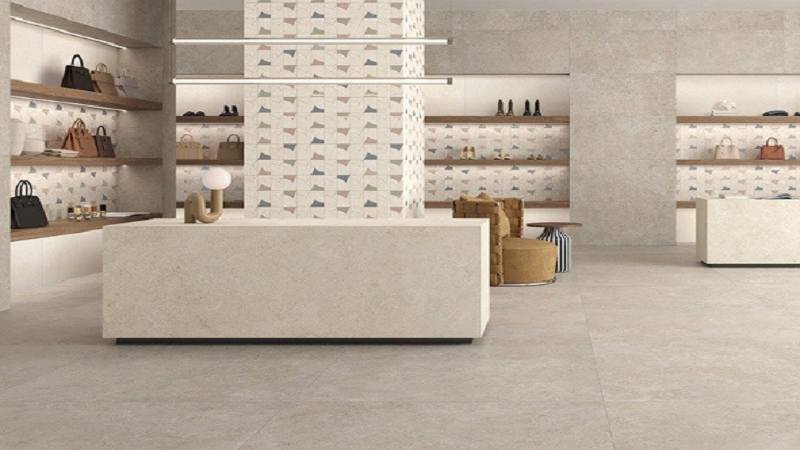
Commercial and public interiors often bring together spaces with very different functions. A hotel lobby, restaurant dining area, retail floor, corridor, or workspace may each require a distinct atmosphere, yet they still need to feel part of the same overall project.
In this context, commercial floor tiles can become more than a practical surface. Through material effects, formats, finishes, and their relationship with wall coverings, they can help establish a recognizable design language that connects different areas while allowing each one to retain its own identity.
Different functions, one recognizable interior identity
A successful commercial interior rarely depends on a single visual gesture. Its identity is usually built through a combination of materials, proportions, lighting, furnishings, and surfaces that recur in different ways throughout the space.
Flooring plays an important role in this system because it accompanies movement from one area to another. A consistent material approach can help visitors understand the relationship between spaces, even when their functions change.
This does not mean using the same surface everywhere. Commercial floor tiles can vary in format, tone, or finish while maintaining a shared visual character. The result is a project that feels connected without becoming repetitive, with each area responding to its own use while remaining part of a broader composition.
Using material effects to create variation without fragmentation
One of the advantages of porcelain stoneware in commercial interiors is the wide variety of visual interpretations available. Marble, cement, stone, and wood effects can support very different atmospheres, from more refined and formal settings to warmer or more contemporary environments.
The key is not simply to combine different effects, but to understand how they interact within the same design concept. A wood-inspired surface may introduce warmth into a workspace or hospitality area, while a cement effect can reinforce a more urban or minimal character. Stone and marble effects can add depth or a stronger sense of material presence.
When selected as part of a coordinated palette, these variations allow designers to differentiate zones without making the interior feel fragmented. Material contrast becomes a way to organize the space while preserving an underlying sense of unity.
Connecting floors and walls as part of the same composition
Visual cohesion can also be created through the relationship between horizontal and vertical surfaces. Floors and walls do not need to be treated as separate elements: together, they can shape the overall perception of the interior.
A wall covering may echo the tone or texture of the floor, reinforce the identity of a specific area, or introduce a more expressive contrast. In hospitality environments, for example, selected wall surfaces can help define reception zones or dining areas. In retail spaces, they can support display areas or highlight specific parts of the customer journey.
This relationship makes it possible to build a richer interior composition without relying on excessive decorative elements. The surfaces themselves become part of the architecture, helping different areas feel intentionally connected.
Adapting the design language to different public environments
The same principle of visual cohesion can be interpreted differently depending on the type of commercial space. A café may call for a warmer, more informal atmosphere, while a hotel may require a more refined visual language. In a workspace, material choices may contribute to a sense of professionalism and reinforce corporate identity.
What remains constant is the need for coherence. In commercial interiors, this does not come from repeating the same finish in every room, but from making different surfaces feel deliberately related. Porcelain floor tiles can help create this connection, allowing public spaces to develop their own character while remaining part of a clear and recognizable design system.
From industrial knowledge to contemporary surfaces: Ceramiche Keope
Contemporary surface design is increasingly defined by choice: different material identities, scales, finishes, and ways of interpreting the same architectural space. Behind this variety, however, lies the ability to reproduce quality with precision and consistency. Ceramiche Keope has developed this balance since 1995, drawing on Italian ceramic culture and an industrial model shaped by continuous research.
Rather than following a single aesthetic direction, the company’s porcelain stoneware collections explore multiple visual languages and application possibilities. Interpretations inspired by wood, stone, marble, and concrete are available across different formats, finishes, and thicknesses, giving designers the freedom to create surfaces with distinct characters for floors and walls, indoors and outdoors.
This breadth becomes particularly relevant in commercial spaces, where every environment needs to express its own identity while responding to intensive daily use.
Shops, cafés, hotels, restaurants, and workplaces can rely on porcelain stoneware surfaces resistant to frequent foot traffic and humidity, while easy cleaning supports everyday management. The variety of material effects also allows flooring and wall coverings to contribute to atmospheres ranging from warm and welcoming to refined, professional, or distinctly contemporary.
The exploration of surface qualities continues with ULTRAsilky and ULTRAmatt. ULTRAsilky combines an extra-smooth, velvety satin texture with enhanced slip resistance for interior wet areas. ULTRAmatt offers a deep extra-matt appearance, a soft and uniform feel, easier maintenance, and R10 A+B performance for residential and commercial floors and walls.
Resource management is embedded in the manufacturing process. A closed-cycle production system enables complete reuse of production water, recovery of fired ceramic waste, and reintegration of raw material residues. Around 75% of the required energy is generated internally, with the remainder supplied exclusively by certified renewable sources.
The certifications ISO 17889, WELL Building Standard V2, and Declare provide further evidence of this commitment to responsible production and transparency. Alongside these references, the Environmental Product Declaration (EPD) offers independently verified information on the environmental impacts of porcelain stoneware throughout its life cycle.
For Ceramiche Keope, industrial knowledge does not lead to uniformity. Its value lies in making different surface identities possible within a consistent standard of quality, giving contemporary projects a broader vocabulary with which to define their own character. See more