
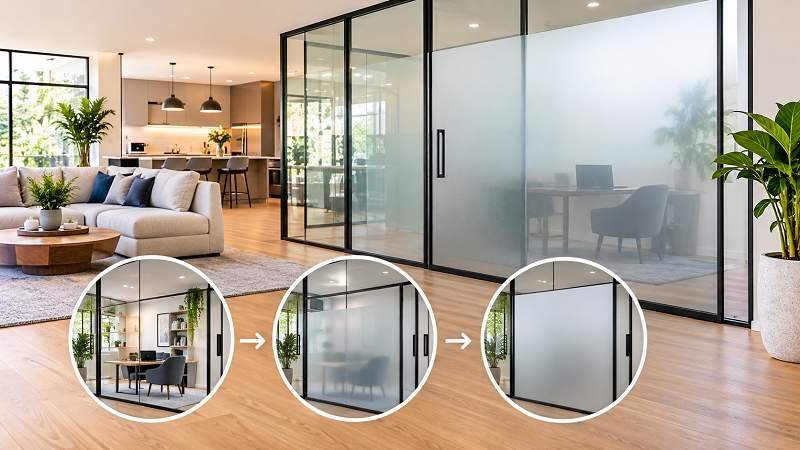
Glass partitions make an open-plan home feel bright and connected, but they also turn a home office, a bedroom, or a bathroom into a display case. Most owners only notice the problem after the glass is installed and the first video call or late-night routine happens in plain view. Switchable privacy film that turns clear glass frosted on demand is one way to fix this without replacing the glass or hanging heavy coverings. This guide shows how to decide where privacy matters, which options fit each room, and how to plan the work properly.
Key Takeaways
- Privacy needs change through the day, so a fixed solution often fails in at least one situation.
- Map each glass surface by who can see through it, when, and for how long before choosing a product.
- Blinds, frosted coatings, and switchable film each suit different rooms; there is no single best answer.
- Electrical planning and glass assessment should happen before purchase, not after.
Why It Matters
Interior glass has moved from a commercial feature to a mainstream residential one. Glass doors, steel-framed partitions, and internal windows borrow light from one room and pass it to the next. The tradeoff is that sightlines travel with the light.
The usual fixes create new problems. Permanent frosting kills the view and the brightness you wanted in the first place. Curtains and blinds collect dust, block daylight when closed, and clutter slim frames that were chosen for their clean look.
That is why flexible privacy has become a design question rather than an afterthought. The goal is not to hide a room all day. It is to hold privacy for the 20 minutes that need it and return to transparency the rest of the time.
Start by Mapping Your Privacy Moments
The right privacy solution depends on when a room needs to be private, not just which room it is. A glass wall that faces a hallway used once an hour is a different problem from one that faces a living area used all evening.
Sort each glass surface into one of three groups
Walk through the home and label every interior glass surface. Use these categories:
- Always private: bathrooms, dressing areas, and bedrooms. Privacy is the default and transparency is the exception.
- Sometimes private: home offices, guest rooms, and media rooms. Privacy is needed during calls, naps, or movie nights.
- Rarely private: kitchens, stairwells, and entry corridors. Light and openness matter most, with occasional privacy when guests visit.
Note the sightline, not just the glass
A partition that faces a blank wall needs less attention than one facing a sofa or a front door. Stand where a person would normally sit in the adjacent room and look through the glass. If you can see a desk screen, a bed, or a changing area, that surface belongs on the priority list.
Consider the time of day
Daylight changes what is visible. A partition may look opaque in the afternoon and become transparent at night when interior lights come on. Check each surface in the evening, since that is when most unwanted exposure happens.
Pro Tip: Test sightlines at night with the lights on. Interior glass that seems private at noon often becomes a window at 9 p.m.
Compare Your Privacy Options
Four approaches cover most interior glass projects: blinds, static frosted film, glass replacement, and switchable film. Each has a place, and the best choice often differs from room to room.
| Option | Privacy control | Light when private | Maintenance | Best for |
| Blinds or curtains | Manual, adjustable | Reduced or blocked | Regular cleaning, moving parts | Windows where a soft look is wanted |
| Static frosted film | None, always frosted | Diffused light passes | Low | Bathrooms and rooms that are always private |
| Glass replacement (frosted or laminated) | Fixed at install | Varies by product | Low | New builds and full renovations |
| Switchable privacy film | On demand, clear or frosted | Diffused light passes | Low, with electrical components | Rooms with changing privacy needs |
Where blinds still make sense
Blinds and curtains remain a sound choice for large exterior windows and for rooms where fabric adds warmth. They are less practical on slim interior partitions, where hardware can look heavy, and fabric may touch the frame.
Where static frosting works
If a surface is private all the time, such as a bathroom door panel, static frosted film is simple and affordable. The limit is obvious: once applied, the glass never becomes clear again.
Where switchable film earns its place
Switchable film suits glass that needs both states. In its clear state, it looks like ordinary glass. When powered off or switched, depending on the system, it turns frosted so people on the other side see light and shapes rather than detail. Its main appeal is control: privacy arrives when needed and disappears when it is not.
What to Know Before Choosing Switchable Film
Switchable film is an electrical product, so planning for power and control is as important as choosing the film. Treat it like any other fixture that needs wiring and a control point.
Power and wiring
The film needs a low-voltage power supply and a path for wiring. In a renovation, that means deciding early where the transformer sits and how wires reach the glass edge. Professional installation and electrical integration reduce the risk of visible cables and poor connections.
Control options
Typical control methods include a wall switch, a remote, and smart-device control. Wall switches suit shared spaces where anyone should be able to toggle privacy. Remote and app control suit rooms where the person inside, such as someone on a call, wants to change the state without getting up.
Glass compatibility
Not every glass surface is a candidate. Film is applied to existing glass in many projects, but the type, condition, and size of the pane should be assessed first. Ask the installer to confirm suitability for your specific glass before ordering anything.
Light, UV, and comfort
Some smart films also block a high share of ultraviolet rays, with figures of up to 99% cited for certain products. That can help protect floors and furniture from fading, though it is a bonus rather than the reason to choose the film. Do not treat it as a promise of lower energy bills, since results depend on the building, the glass, and how the space is used.
What the film does not do
Film is a visual privacy tool. It does not make a wall soundproof, and it should not be treated as a security measure. If acoustic separation matters, plan separate solutions such as sealed frames or added insulation.
A Concrete Example: The Split-Level Loft
Consider a two-story loft with a glass partition between an upstairs home office and the main living area. The owners loved the borrowed daylight, but video calls meant colleagues could see the family on the sofa, and the family could see the screen.
They mapped the space and sorted their glass:
- Office partition: sometimes private. Needs on-demand control during calls.
- Bathroom door panel: always private. Static frosting was enough.
- Stairwell glass: rarely private. Left clear.
They applied switchable film to the office partition only, placed a wall switch inside the office, and added app control for convenience. The bathroom panel received simple frosted film, which cost less and needed no wiring.
The result was not a single product used everywhere. It was a layered plan where each surface got the lightest solution that solved its specific problem. That approach also kept the electrical work limited to one location.
Key Insight: The cheapest plan is rarely one product across the whole home. Match each surface to its real privacy pattern, and you spend only where flexibility is needed.
Plan the Installation Properly
A good installation starts with measurement and electrical planning, not with ordering film. Rushed projects tend to end with visible wires, awkward switch placement, or glass that turns out to be unsuitable.
Before the installer arrives
- Photograph each glass surface and measure width and height.
- Note the glass type if known (clear, tempered, laminated, or coated).
- Mark where a power source is available.
- Decide who will use the controls and where they should sit.
During the project
Expect the installer to check the glass, clean the surface, apply the film, connect the electrical components, and test both states. Timelines vary with glass size, site access, and the number of panels, so treat any schedule as an estimate rather than a fixed promise.
After installation
Test the film in both states at different times of day. Confirm the controls work from each location. Ask about the product and installation warranty options and read the terms before relying on them.
Actionable Takeaways
- List every interior glass surface and sort it as always, sometimes, or rarely private.
- Check sightlines at night with interior lights on.
- Use static frosting for always-private panels and flexible solutions for sometimes-private ones.
- Choose control methods based on who needs to switch privacy and where they will be standing.
- Plan power and wiring before ordering, and have the glass assessed for compatibility.
- Ask for written warranty details and treat timelines as estimates.
Conclusion
Open-plan design does not have to mean constant exposure. The most livable homes treat privacy as something that changes through the day and choose tools that follow that rhythm. Map the glass, match each surface to a realistic need, and plan the practical details early. The light stays, and the fishbowl feeling goes.
FAQ
How do I add privacy to interior glass without blocking light?
Frosted or switchable treatments add privacy while still letting diffused daylight through. Blinds and curtains reduce light more noticeably when closed. The best choice depends on whether the room needs privacy all the time or only occasionally.
Is switchable privacy film suitable for every glass surface?
No, suitability depends on the type, condition, and size of the glass. Film is often applied to existing glass, but a professional assessment should confirm it before purchase. Ask the installer about your specific panes.
Does smart privacy film need electricity?
Yes, switchable film requires a low-voltage power supply to change between clear and frosted states. A wiring path and transformer location should be planned before installation. Professional electrical integration helps keep cables neat and connections reliable.
Can privacy film make a room soundproof?
No, privacy film changes what people can see, not what they can hear. If sound separation matters, look at sealed frames, added insulation, or acoustic glazing alongside any visual privacy solution.
What is the difference between static frosted film and switchable film?
Static frosted film stays frosted permanently, while switchable film can change between clear and frosted. Static film is simpler and costs less. Switchable film suits spaces that need both openness and privacy at different times.
Where should I put the controls for smart privacy glass?
Place a wall switch where people naturally enter or sit, and consider remote or smart-device control for rooms used for calls or rest. The best location is the one the person using the room can reach without interrupting what they are doing. See more