
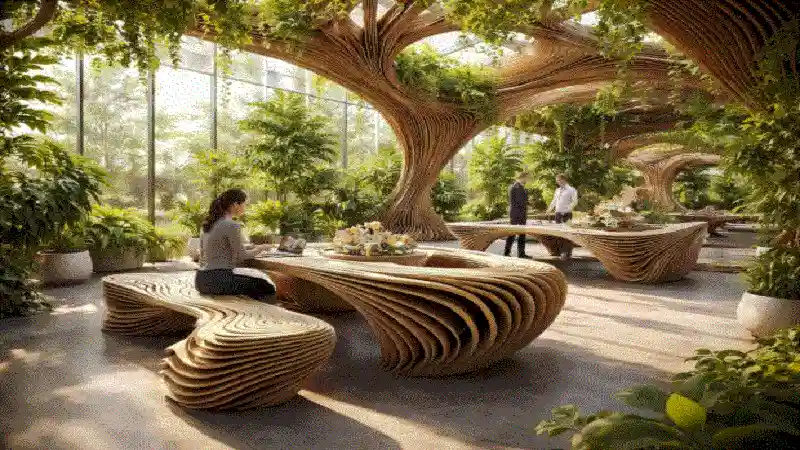
Sustainability has moved far beyond being a passing trend—it is now a defining principle shaping modern architecture. Across regions like the UK, the US, and beyond, industry professionals are rethinking how buildings and interiors are conceived, designed, and manufactured.
With increasing pressure to cut carbon emissions, reduce material waste, and comply with stricter environmental regulations, innovation is no longer optional—it’s essential.
In the UK alone, it contributes roughly a quarter of total greenhouse gas output. On a global scale, construction activities account for nearly 37% of energy-related carbon emissions. These figures highlight the urgent need for smarter, more sustainable design approaches.
One such approach gaining rapid traction is Parametric Furniture Design.
Understanding Parametric Furniture Design
Parametric Furniture Design is a digital design methodology that relies on algorithms and adjustable parameters rather than fixed measurements.
Instead of creating static furniture layouts, designers define relationships and rules. This allows designs to automatically adapt when dimensions or conditions change.
For instance:
- Modifying seat height can instantly adjust support angles
- Changing room dimensions can update storage layouts
- Altering material thickness can automatically refine joinery details
This approach enables highly flexible, efficient, and scalable furniture solutions tailored to specific spaces and requirements.
When integrated with modern 3D design and drafting services, parametric models can be directly translated into production-ready outputs.
Why Sustainability Is Driving This Shift
Sustainable architecture is built on key principles: efficiency, adaptability, durability, and minimal waste. Parametric design supports all of these goals in powerful ways.
1. Smarter Material Usage
Parametric tools optimize material layouts with precision. Instead of relying on manual estimates, algorithms calculate exact cutting patterns, significantly reducing waste.
This leads to:
- Less material offcuts during production
- Lower raw material costs
- Reduced transportation impact
In markets focused on achieving net-zero targets, such efficiency is invaluable.
2. Design for Longevity and Reuse
Modern sustainability emphasizes circular design—products that can be reused, repaired, or recycled.
Parametric workflows allow designers to test modular connections and disassembly strategies digitally before manufacturing. This results in furniture that is:
- Easier to repair
- Adaptable to future needs
- Designed for long-term use
3. Faster and More Efficient Iteration
Traditional design revisions can be time-consuming. Parametric systems, however, allow instant adjustments.
Designers can quickly:
- Test alternative materials
- Optimize structural performance
- Refine dimensions
This reduces reliance on physical prototypes, saving both time and energy during development.
Transforming Modern CAD Workflows
The CAD landscape has evolved significantly in recent years. Static 2D drawings are being replaced by intelligent, interconnected design systems.
Parametric Furniture Design enhances CAD workflows by:
- Automating repetitive design tasks
- Ensuring consistency across components
- Updating entire assemblies dynamically
- Improving collaboration between teams
For furniture brands and manufacturers, this means fewer production errors and greater scalability.
Reducing Prototyping Costs Through Digital Design
Physical prototyping can be expensive and resource-intensive. Parametric design minimizes this need through advanced digital simulations.
With photorealistic 3D visualization, businesses can:
- Evaluate design aesthetics
- Test proportions and functionality
- Present realistic concepts to clients
- Gain approvals before production
This significantly cuts down on costly trial-and-error processes.
Research in digital manufacturing shows that companies adopting such technologies can improve productivity by up to 30%, making parametric design a valuable investment.
Why the UK Market Is Leading Adoption
The UK has become a hotspot for parametric design adoption due to several factors:
- Strong sustainability regulations
- Limited urban space
- High demand for customized interiors
- Growth in modular construction
In cities like London, where compact living is common, adaptable furniture solutions are essential. Parametric design allows furniture to seamlessly fit into:
- Irregular layouts
- Sloped ceilings
- Multi-functional living areas
Supporting the Growth of Modular Construction
Modular construction is expanding rapidly, particularly in developed markets. Since components are prefabricated, precision is critical.
Parametric design ensures that furniture integrates perfectly with structural modules, offering:
- Faster installation
- Better alignment with building frameworks
- Improved coordination during off-site manufacturing
Integration with Automation and CNC Technology
Modern manufacturing relies heavily on automation and CNC machinery. Parametric design produces machine-ready data that integrates directly with these systems.
This enables:
- Accurate cut lists
- Detailed assembly instructions
- Consistent production quality
- Minimal manual errors
The result is a more efficient and sustainable production process.
Challenges to Consider
Despite its advantages, implementing parametric design comes with certain challenges:
- Skill Requirements: Advanced tools require specialized knowledge
- Initial Costs: Software and training can be expensive
- Workflow Changes: Integration with existing systems may take time
However, these challenges can be addressed through strategic planning or by partnering with experienced design professionals.
Enhancing Client Communication
One of the most overlooked benefits of parametric design is improved communication.
With realistic 3D visualizations, stakeholders can:
- Clearly understand design intent
- Explore customization options
- Evaluate materials and structure
This reduces misunderstandings and prevents costly changes later in the project.
A Powerful Tool for Startups
Parametric Furniture Design is particularly beneficial for startups looking to compete in modern markets.
It allows businesses to:
- Launch multiple product variations بسرعة
- Offer customization without complexity
- Create digital-first marketing assets
- Scale production efficiently
Startups can access advanced capabilities without needing large in-house teams.
What Lies Ahead
The future of furniture design will be shaped by the convergence of digital technologies and sustainability.
Key trends include:
- AI-driven design optimization
- Generative design for material efficiency
- Integration with BIM systems
- Cloud-based collaborative platforms
As architecture becomes more data-driven, furniture design must evolve alongside it.
Final Thoughts
The transition toward sustainable architecture is accelerating, and Parametric Furniture Design is playing a crucial role in that transformation.
It empowers businesses to:
- Reduce waste and environmental impact
- Improve production efficiency
- Support modular construction
- Increase design flexibility
- Lower development costs
While adopting parametric workflows requires investment and planning, the long-term benefits in sustainability and competitiveness are substantial.
In today’s evolving design landscape, parametric furniture is no longer a niche innovation—it is quickly becoming the industry standard.
FAQs
1. What is Parametric Furniture Design?
It is a digital design approach that uses algorithms and adjustable parameters to create flexible and customizable furniture models.
2. How does it support sustainability?
It reduces material waste, improves efficiency, and minimizes the need for physical prototypes.
3. Is it widely used in the UK?
Yes, due to strict sustainability goals and demand for efficient, space-saving designs.
4. Can it lower prototyping costs?
Absolutely. Digital visualization reduces the need for multiple physical prototypes.
5. What tools are used?
Common tools include AutoCAD, BIM platforms, and generative design software.
6. Is it suitable for startups?
Yes, it allows rapid design, customization, and scalability with lower upfront costs.